

New Book Sets Standard for Building Human Capability in the Classroom and the Workplace
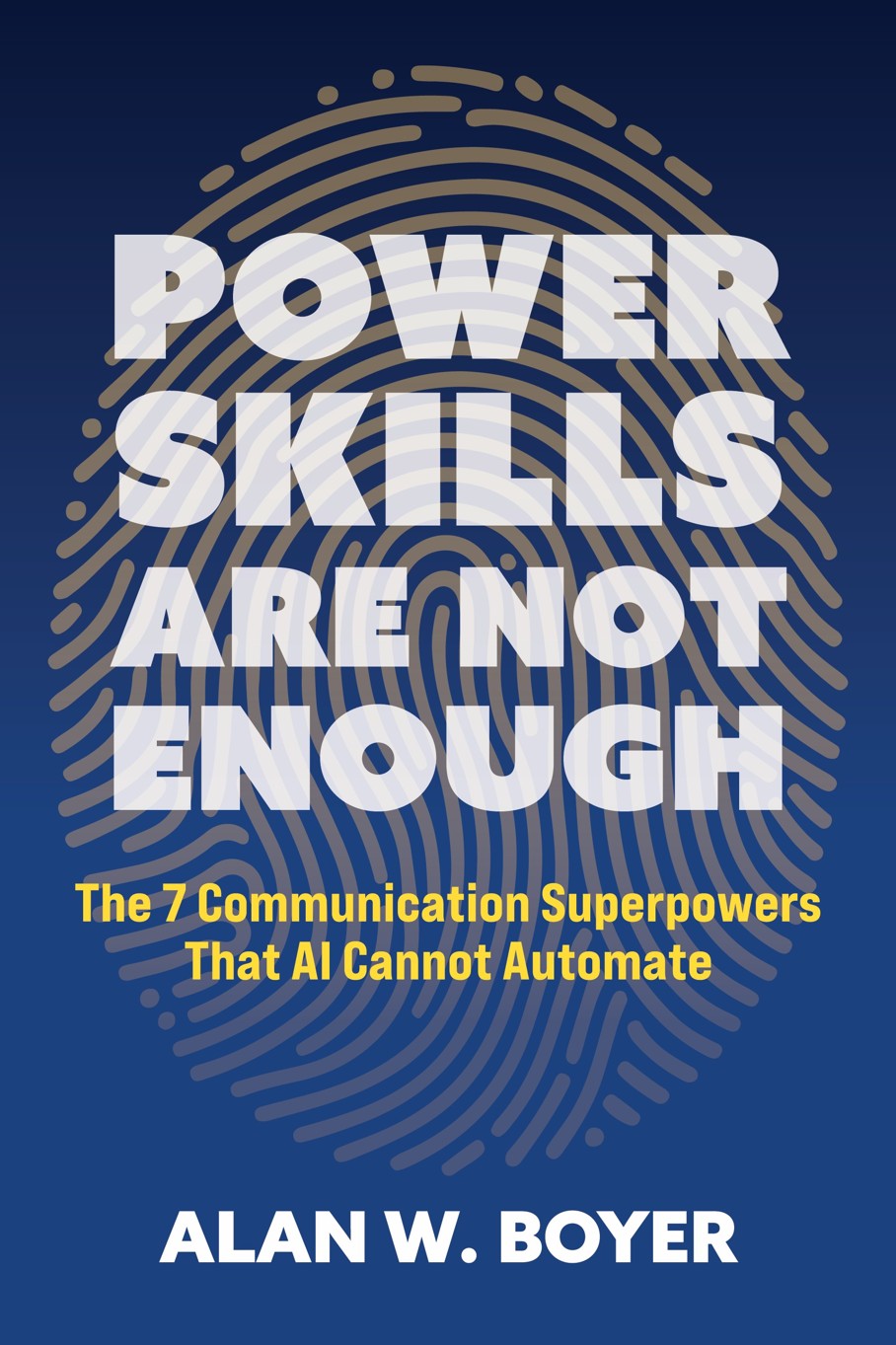
The 7 Communication Superpowers That AI Cannot Automate
A practical, research-grounded primer for preparing graduates and elevating employees for the emerging human skills economy
AI didn’t lower the bar on power skills; it revealed the ceiling they were inevitably going to hit in an AI-driven workforce.”
ATLANTA , GA, UNITED STATES, July 20, 2026 /EINPresswire.com/ -- As AI accelerates work, educators and leaders must elevate human capabilities. That is the central argument of a new book by higher education innovator, management professor and four-time Fortune 500 executive Alan Boyer, whose “Power Skills Are Not Enough: The 7 Communication Superpowers That AI Cannot Automate” sets a standard for how educators and employers build human capabilities in the classroom and the rapidly automating workplace. — Alan Boyer
Rather than cataloging AI tools, the book names seven specific, teachable capabilities AI cannot replicate: Cognitive Power, Systems Intelligence, Global and Cultural Signal Fluency, AI Fusion, Fluid Adaptation, Influence Engine and Insight Engineering. Boyer offers educators and business leaders a practical guide to develop talent that thrives in tandem with AI, rather than in competition.
“For two decades I sat on the hiring side of the table as a marketing executive, and for another two decades I sat on the curriculum side as an educator,” Boyer said. “Both sides are converging upon the same problem: as AI takes over execution, the gap isn’t technical skill, it is human capability. This book names that gap and gives educators and employers a pathway to close it.”
Boyer brings a dual-career perspective as a marketing executive at AT&T, Coca-Cola, Equifax and First Data, followed by an equal tenure as a curriculum architect and educator across more than a dozen higher education institutions. He is the founding managing partner of iThrive Learning Architects and teaches in the School of Business at Georgia Gwinnett College. His course designs serve a consortium of 120 colleges and universities. He is also the founding director of a nationally recognized digital innovation degree and certification program, which he created to directly address critical employer demand.
“AI didn’t lower the bar on power skills; it revealed the ceiling they were inevitably going to hit in an AI-driven workforce,” Boyer said. “While still important, these skills were built for an era of slower change and gradual development—and that era is over.”
Research increasingly confirms not just that human capabilities matter more as AI reshapes work, but that higher education and learning and development professionals need a roadmap to build them deliberately.
● Pearson x Amazon Web Services "AI Readiness" report (2026): finds the traditional cadence of curriculum development is out of sync with the pace of AI-driven change, and that universities are falling behind not for lack of will, but because higher education's underlying governance model was never built to iterate at this speed.
● "Towards a Future Skills Framework for Higher Education" (Springer Nature, peer-reviewed): finds that existing work on future skills lacks a clear theoretical foundation for what constitutes human competence or how it develops, and that no shared, universal way exists yet to translate these skills into coherent curriculum design.
● International Workplace Group (IWG) survey of 510 U.S. HR, recruitment, and hiring managers (April 2026): finds 90% of HR leaders believe failing to prioritize human capabilities is a risk to innovation, describing an emerging "human skills economy" in which most organizations still lack a deliberate strategy for building these capabilities rather than leaving them to chance.
With "Power Skills Are Not Enough," higher education and learning and development professionals now have a roadmap to build these capabilities deliberately – beyond a list of skills to admire – and a case for designing human capability into curriculum and professional development by intention, not accident.
“This book is intended to be an actionable guide, not simply theory,” Boyer said. “Educators and employers are overwhelmed with information about AI but lack a roadmap. The seven communication superpowers provide a tangible starting point to immediately redesign coursework and facilitate thoughtful student conversations.”
About Power Skills Are Not Enough
Published by iThrive Learning Architects LLC, “Power Skills Are Not Enough: The 7 Communication Superpowers That AI Cannot Automate,” by Alan Boyer, provides a structured pathway to building resilient talent. Designed for immediate classroom or workplace use, each chapter functions as a practical workbook featuring real-world case studies, actionable assignments and reflection questions. The book debuted as the No. 1 new release in business school guides on Amazon and has been adopted into undergraduate curricula at major research universities and business schools. Learn more at ithrivelearning.com.
###
Nancy Tao
Tao Communications
+1 404-472-6895
nancy@taocomms.com
Visit us on social media:
LinkedIn
Instagram
Legal Disclaimer:
EIN Presswire provides this news content "as is" without warranty of any kind. We do not accept any responsibility or liability for the accuracy, content, images, videos, licenses, completeness, legality, or reliability of the information contained in this article. If you have any complaints or copyright issues related to this article, kindly contact the author above.
